
Blog: Innovations & Insights
May 2026
What Manufacturers Look for in High-Performance Cutting Systems
Cutting system specifications read like automotive brochures—impressive numbers that may or may not reflect real-world performance. Maximum throughput assumes ideal conditions that production floors never deliver. Blade life projections come from controlled tests using virgin materials at optimal temperatures. Equipment that performs brilliantly in demonstrations sometimes struggles with actual production demands. Experienced manufacturers learned to look past specifications to the fundamental capabilities that determine whether cutting systems deliver day after day. They’ve developed evaluation frameworks built from hard experience—lessons learned from equipment that promised everything and delivered frustration.
Consistency Over Peak Performance
The single metric separating acceptable from excellent cutting systems isn’t maximum throughput but consistent throughput across varying conditions. Any system performs well when everything goes right. Only reliable systems maintain performance when materials vary, temperatures fluctuate, and conditions change unpredictably.
Pelletizing knives that cut cleanly at design throughput but struggle when feed rates vary reveal fundamental limitations. Production rarely runs at constant rates—startups, material transitions, and process variations create conditions that expose marginal designs. The cutting system that maintains quality through these variations proves its actual value.
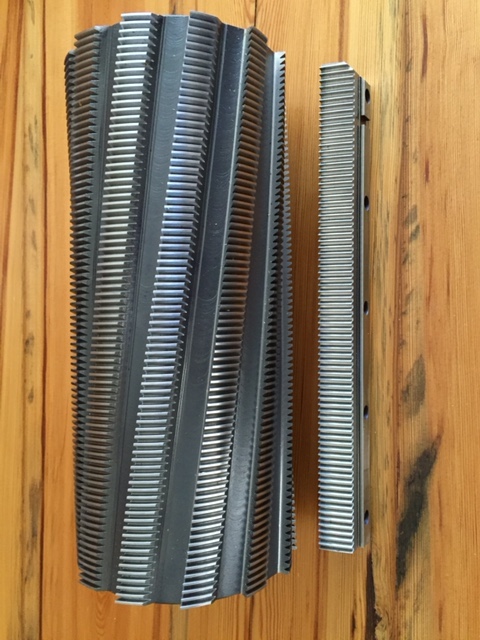
Helical pelletizer designs demonstrate this principle effectively. The progressive cutting action that characterizes helical geometry reduces load spikes from full-width engagement, creating more consistent cutting forces despite feed variations. This consistency translates directly into more uniform pellet quality throughout production runs rather than just during optimal conditions.
Experienced purchasing teams test cutting systems under worst-case conditions rather than ideal ones. They run variable feed rates, switch materials mid-test, and introduce the kinds of variations that characterize real production. Systems that maintain performance through these conditions earn consideration. Those that only perform well under ideal circumstances get eliminated regardless of specifications.
Mechanical Precision That Holds
High-performance cutting systems maintain dimensional accuracy not just when new but throughout extended service. The tolerances that determine cut quality gradually drift as components wear, thermal cycling affects fits and clearances, and vibration loosens what assembly procedures tightened.
Pelletizer rotor design determines how well systems maintain precision over time. Rotors that deflect under cutting loads create varying clearances that affect cut quality. Those engineered with appropriate stiffness maintain blade positions despite the forces that try to move everything. This structural integrity determines whether systems still perform acceptably after months of continuous operation.
Bearing selection and mounting systems deserve scrutiny during evaluation. Pelletizing rotors transmit substantial forces through bearing systems that must maintain positioning accuracy while handling loads. Undersized bearings might meet initial specifications while failing prematurely. Proper bearing selection for actual loads rather than theoretical minimums determines long-term precision.
Thermal management affects precision throughout production shifts. Equipment that expands unevenly during warm-up creates alignment problems that don’t exist at startup. Cutting systems that account for thermal growth through design—rather than hoping operators make compensating adjustments—maintain precision automatically. This thoughtful engineering reveals manufacturing quality better than any specification.
Material Handling Capability
Manufacturers processing multiple materials need cutting systems that handle their entire range rather than optimizing for one grade. The system perfect for rigid engineering plastics might struggle with flexible compounds. Equipment excellent at processing virgin materials might fail with recycled content containing unknown additives.
Pelletizing knives designed for specific material ranges perform better than universal designs that compromise everything. But the range must realistically cover actual production requirements. Operations switching materials frequently need cutting geometry that handles transitions without extended adjustment periods.
Feed system integration affects material handling significantly. How strands, melt, or bulk material presents to cutting elements determines whether theoretical blade performance actually materializes. Poor feed system design creates uneven material distribution that defeats excellent cutting geometry. Complete system evaluation—not just cutting elements—reveals actual capability.
The helical pelletizer approach addresses material handling through geometry that works with material properties rather than fighting them. Progressive engagement creates pulling action that helps maintain consistent feed rather than creating intermittent surges that challenge both cutting and feeding systems.
Maintenance Accessibility
High-performance means nothing if achieving it requires constant downtime for maintenance. Manufacturers evaluate cutting systems on how quickly and easily maintenance procedures can be completed, understanding that maintenance time directly subtracts from production time.
Blade access determines change-over time that affects actual production capacity. Pelletizing rotors requiring extensive disassembly for blade changes cost hours of production every maintenance cycle. Systems designed for quick blade access might sacrifice some structural elegance but deliver better effective capacity through faster changeovers.
Component standardization reduces inventory requirements and simplifies maintenance logistics. When pelletizing knives, bearings, and wear parts use standard specifications rather than proprietary dimensions, maintenance becomes simpler and less expensive. This consideration rarely appears in initial specifications but significantly affects long-term operating costs.
Diagnostic accessibility enables condition monitoring that prevents failures rather than just responding to them. Systems that provide visibility into operating conditions—temperatures, pressures, vibration levels—enable predictive maintenance that eliminates most unplanned downtime. This capability transforms maintenance from reactive scrambling to planned efficiency.
The Integration Requirement
Cutting systems don’t operate independently—they must integrate with upstream processing and downstream handling to deliver complete system performance. Manufacturers evaluate how well cutting systems accept material from upstream processes and deliver consistent output to downstream equipment.
Control system integration enables the automatic adjustments that maintain quality despite process variations. Cutting systems that respond to upstream conditions—adjusting speeds or pressures based on melt flow or strand consistency—maintain quality more effectively than those requiring constant manual intervention.
The manufacturers who build consistently superior products understand that cutting system selection involves complete system evaluation rather than individual component specifications. They look for systems where every element—pelletizer rotor design, blade geometry, feed systems, controls—works together toward consistent performance. That integration, more than any individual specification, determines whether cutting systems deliver on their performance promises.