
Blog: Innovations & Insights
May 2026
Reducing Dust and Fines in Modern Pellet Production Systems
Dust and fines percentages rarely appear in initial equipment discussions but show up everywhere else—in quality complaints, material losses, housekeeping costs, and customer attrition. Pellet producers accept fines as inevitable byproducts rather than preventable problems, building entire material handling systems around managing what should never have been generated. The operations that finally treat dust and fines as engineering problems rather than operational inevitabilities discover how much money they’ve been losing. Solutions exist throughout the production system, but finding them requires understanding where fines actually originate rather than where they most visibly appear.
Where Fines Really Come From
Blaming fines on material properties or downstream handling misses the actual generation points. Most dust and fines originate at the cutting zone, created in the moment polymer separates. How that separation happens—cleanly or poorly—determines whether you produce pellets or pellets plus expensive waste.
Pelletizer blades that tear rather than cut create fines at the cutting interface. The difference between shearing and tearing happens in milliseconds but produces dramatically different results. Sharp, properly angled blades create clean separation with minimal material displacement. Dull or incorrectly angled blades drag through material, displacing polymer sideways rather than cutting forward. That displaced material becomes fines.
Pelletizer dies contribute equally but get examined less frequently. Die holes with rough internal surfaces create turbulence that affects how polymer exits. Exit velocity variations across different holes create material that cuts inconsistently—some strands perfect, others prone to fines generation. The die face condition, hole geometry, and land length all affect how material presents to cutting elements.
Temperature distribution across pelletizer dies affects fines more than most operations realize. Cold zones create high-viscosity material that resists clean cutting. Hot zones produce material that deforms rather than cuts cleanly. The 5-10°F variations that seem insignificant translate directly into fines generation that seems mysterious until you map die temperatures properly.
The Underwater Pelletizing Advantage
Underwater pelletizing systems naturally reduce fines compared to strand cutting when properly optimized. The immediate water contact after cutting quenches pellet surfaces before they can deform or generate dust. Pellets solidify quickly into stable shapes that resist fines generation during subsequent handling.
But underwater pelletizing creates its own fines risks when operating parameters drift from optimal. Water temperature affects quench rates that determine pellet surface quality. Too cold and thermal shock creates micro-fractures that generate fines during handling. Too warm and pellets remain soft enough to deform in the water circuit, creating irregular shapes that break down later.
Die face temperature management becomes critical in underwater pelletizing systems. The water that quenches pellets also tries to cool the die face, creating competing thermal demands. Proper balance maintains die temperature for good flow while allowing adequate quench rates for surface quality. Drift in either direction increases fines generation in ways that seem related to everything except the actual cause.
Blade-to-die clearance in underwater pelletizing deserves constant attention because it changes continuously. Thermal expansion, blade wear, and pressure variations all affect the gap that determines cut quality. Clearance that produces minimal fines at startup might generate significant waste after two hours of operation as everything heats up and expands.
Helical Geometry Benefits
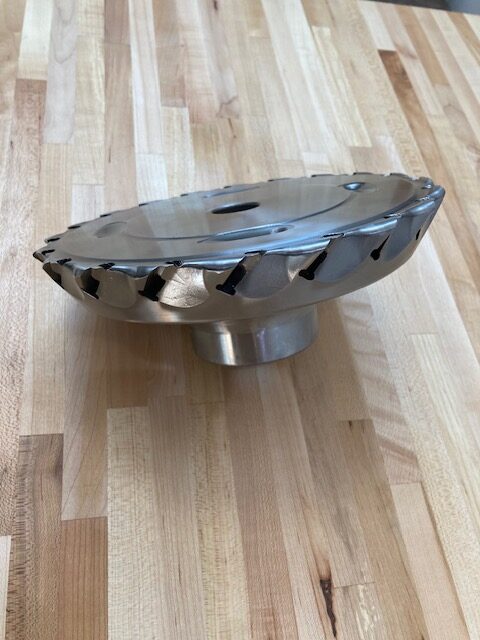
Helical pelletizer designs address fines generation through cutting geometry that reduces the impact loading responsible for material displacement. Traditional straight-blade cutting engages the full blade width simultaneously, creating sudden load spikes that displace material sideways. Helical geometry engages progressively, creating slicing action that generates significantly less displaced material.
The fines reduction from helical pelletizer designs often surprises operations switching from straight-blade equipment. The same material that generated 1.5% fines with straight blades might produce 0.6% with helical geometry. The percentage difference seems small until you calculate tonnage—on a 10,000 lb/hr line, that’s 90 pounds per hour of prevented waste.
The progressive engagement that reduces fines also reduces noise and vibration. These secondary benefits indicate the fundamental mechanical improvement that helical geometry delivers. Lower vibration means better maintained clearances, which further reduces fines. The initial geometry improvement creates positive cascades throughout system performance.
System-Level Solutions
Addressing fines requires examining complete production systems rather than individual components. Upstream melt quality affects how cleanly material cuts. Downstream handling determines whether well-cut pellets survive intact or generate fines through impact and abrasion.
Strand temperature at the cutting point affects fines generation significantly. Material arriving too cold resists clean cutting and generates fines from brittle fracture. Material arriving too hot deforms rather than cutting cleanly. The narrow optimal temperature range varies by material but always exists—finding it reduces fines without any equipment changes.
Pellet transport systems generate fines from perfectly cut pellets through impact and abrasion. High-velocity pneumatic conveying creates impact events at every bend and transition. Excessive conveying speeds, sharp elbows, and rough pipe surfaces all contribute. Reducing conveying velocity, using long-radius elbows, and specifying smooth interior surfaces can reduce handling-generated fines dramatically.
Air classification systems capture unavoidable fines before they reach customers, but should be considered supplementary rather than primary solutions. Operations that rely entirely on classification to manage fines accept the material loss rather than preventing it. Prevention at generation points always provides better economics than recovery after generation.
The Measurement Discipline
Reducing fines requires measuring them systematically rather than estimating. Many operations discover their actual fines percentages significantly exceed estimates when measured precisely. This baseline measurement enables evaluating whether changes actually improve performance.
Measuring fines at multiple points—at the cutter, after water separation, after drying, after conveying—identifies where generation and accumulation occur. This data guides targeted improvements rather than scattershot changes that might not address actual problem points.
The operations that achieve genuinely low fines percentages treat measurement as an ongoing discipline rather than a periodic exercise. They track trends, investigate increases immediately, and correlate fines generation with operational parameters. This systematic approach converts fines reduction from aspiration into achievement.