
Blog: Innovations & Insights
April 2026
From Waste to Value: The Role of Granulating Blades in Closed-Loop Recycling Systems
Closed-loop recycling sounds elegant in sustainability reports—waste material continuously reprocessed into valuable feedstock without leaving the facility. The reality involves considerably more violence. Before that waste plastic becomes usable material again, it must be shredded, ground, and reduced from irregular chunks into consistent particles that processing equipment can handle. None of that happens without granulating blades doing brutal work reliably, continuously, and precisely. The gap between recycling ambition and recycling reality often comes down to whether cutting equipment can handle the punishment that closed-loop systems demand. Operations that underestimate this discover their sustainability goals colliding with maintenance realities that nobody anticipated.
What Closed-Loop Actually Demands
Closed-loop recycling within manufacturing facilities processes scrap, purge, and off-spec material back into production feedstock. Unlike post-consumer recycling with its random contamination, closed-loop handles known materials—but known doesn’t mean easy. Purge material contains degraded polymer with changed flow characteristics. Edge trim includes mixed thicknesses that present inconsistently to cutting equipment. Rejected parts might contain pigments, fillers, or additives that affect how material cuts.
Granulator blades in these systems run continuously rather than in scheduled batches. Production generates scrap constantly, meaning granulators must process material as fast as it arrives. Intermittent bursts of thick purge alternate with continuous thin film trim. Heavy glass-filled rejects follow soft flexible sections. The equipment must handle everything without adjustment, hesitation, or failure.
Throughput consistency matters more than peak performance. A granulator that processes purge brilliantly but struggles with film creates bottlenecks that back up production. Granulating blades must handle the entire material range consistently, maintaining output rates that match production scrap generation. Fall behind and scrap accumulates, creating handling problems and production disruptions.
The Cutting Challenge
The physics of granulating recycled material differs significantly from processing virgin feedstock. Degraded polymer behaves unpredictably. Molecular weight reduction from previous heat cycles changes how material responds to cutting forces. Materials that cut cleanly when fresh might stretch or tear after recycling, requiring different blade geometry for acceptable results.
Granulator knives encounter thickness variations that create wildly different load profiles. Thin film requires sharp edges with minimal cutting force. Thick purge demands robust geometry that handles heavy loads without deflection. The same blade must handle both conditions within seconds of each other. Edge geometry that optimizes for one condition might compromise performance on the other.
Temperature variations complicate cutting further. Fresh purge arrives hot, behaving differently than cooled scrap. Summer versus winter temperatures affect how rigid polymers respond to cutting. The granulating blades that perform optimally at one temperature might struggle as conditions change. Equipment that can’t adapt to these variations creates inconsistent particle size that reduces recyclate value.
Sheeter knives face similar challenges when processing film and sheet trim in closed-loop systems. These blades must handle both fresh trim with good material properties and returned material with degraded characteristics. The performance envelope that matters isn’t peak capability but consistent operation across variable conditions.
Blade Design for Recycling Reality
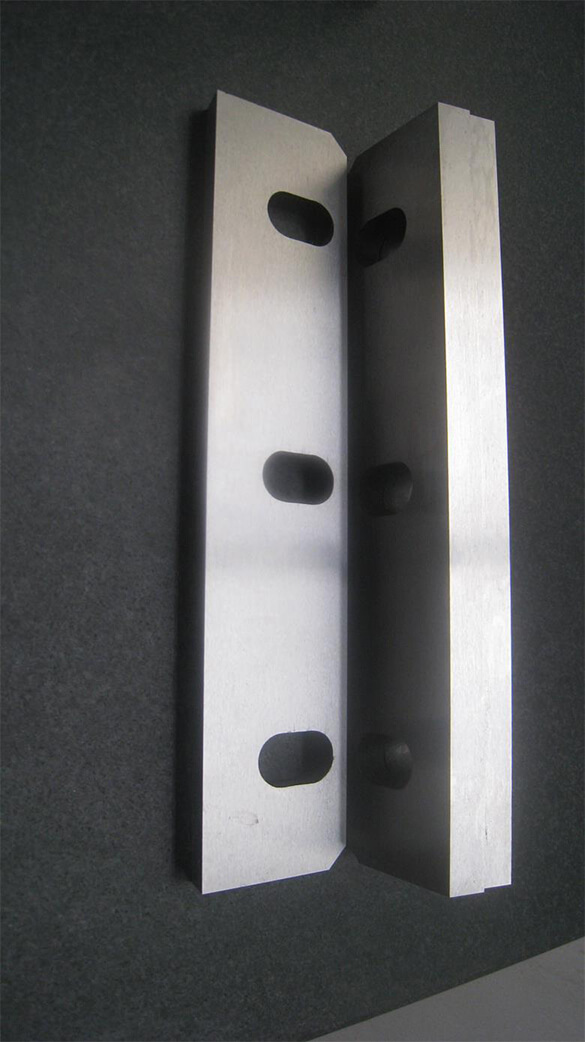
Granulator blade design for closed-loop applications requires compromises that pure performance optimization wouldn’t accept. The blade perfect for clean virgin material might fail within hours in recycling duty. Successful designs balance multiple competing requirements.
Edge geometry takes priority over pure sharpness. Acute angles cut cleanly but chip when encountering thick purge sections or contamination. More obtuse edges sacrifice some cutting efficiency but survive the variable loads typical in recycling applications. The geometry that maximizes performance in consistent conditions often fails in variable ones.
Material selection reflects the dual demands. Granulating blades need enough hardness to resist abrasion from filled materials while maintaining toughness for impact events. Premium tool steels and carbide grades optimized for recycling applications balance these properties better than materials designed for single-purpose cutting.
Edge preparation matters as much as base geometry. Micro-bevels behind primary cutting edges prevent chipping under impact loads. Specific surface finishes reduce material adhesion that creates buildup problems. These details separate granulator knives that thrive in recycling applications from those that merely survive.
Maintenance Reality
Closed-loop systems run continuously, making maintenance timing critical. Granulating blades can’t be changed whenever convenient—they must be maintained around production schedules that don’t accommodate discretionary downtime.
Sharp blades matter more in recycling applications than most realize. Dull granulating blades don’t just cut poorly—they generate heat that further degrades already-compromised polymer. This creates a cascade where dull blades produce lower quality recyclate that processes worse, generates more heat, and creates more problems downstream.
Monitoring blade condition continuously rather than on scheduled intervals prevents the quality degradation that appears gradually. Particle size distribution provides the most reliable indicator—when distribution spreads and fines increase, blades need attention before obvious problems force unplanned shutdowns.
Blade rotation strategies extend overall life while maintaining performance. Rather than running blades to failure, rotating positions distributes wear across multiple surfaces. Reversible granulating blades can extend service intervals significantly, reducing maintenance frequency in systems where downtime is genuinely expensive.
The System Perspective
Granulating blades don’t operate independently—they’re integrated into material flow systems where performance affects everything upstream and downstream. Poor cutting creates particles that process inconsistently, affecting extruder performance, pellet quality, and final product properties.
Closed-loop recycling delivers its promised value only when every system component performs reliably. The granulating knives that reduce scrap to consistent feedstock enable everything else—filtration, extrusion, pelletizing—to function properly. Compromising blade performance and the entire system produces inferior recyclate that undermines both economic and sustainability goals.
The facilities that achieve genuine closed-loop efficiency treat granulating blades as production-critical components rather than consumable commodities. They specify appropriate blade materials for recycling demands, maintain sharp edges proactively, and understand that blade performance directly determines recyclate quality and system economics.